

Retain control with clear optimization limits
Existing controllers retain basic control while OptimLight adjusts setpoints only within authorized limits.
Move industrial parameter tuning from repetitive manual trials to data-driven iteration. OptimLight uses intelligent algorithms to help teams explore better setpoints more efficiently and turn every run into reusable, traceable engineering knowledge.

OptimLight optimizes parameters with intelligent algorithms such as heuristic search, machine learning, and reinforcement learning (in development), performs online adjustment under the closed-loop iteration framework of Plan – Act – Settle – Observe, and achieves cross-scenario generality through configurable tuning tasks and standardized field-adaptation interfaces, building an intelligent online parameter tuning platform for industrial fields.
Existing controllers retain basic control while OptimLight adjusts setpoints only within authorized limits.
Search for better parameters against measurable objectives and constraints, without a first-principles process model.
Retain configurations, actions, and observations for review, sharing, and reuse.
RuntimeWindows host at the site with LAN browser access
ProblemMeasurable objectives with defined constraints and parameter limits
AccessReadable operating data and authorized setpoint writes
Interacting setpoints, delayed responses, and changing field conditions make one-off calculation insufficient for sustained tuning.

Multiple setpoints act together. Objectives, constraints, and parameter limits must be considered as a whole rather than tuned one by one.
A transient response after a write is not the final outcome. The process needs to settle before objectives and constraints are evaluated over an observation window.
Load, feedstock, and equipment condition can change. A setpoint combination that worked before may not remain suitable, so tuning must respond to actual feedback.
From candidate setpoints to field feedback, every step has a clear purpose and every iteration leaves a record.

Continuous iteration, human controlObservations inform the next planning step. Set termination conditions and stop, pause, or resume whenever the run state allows.
Connect task setup, online execution, tuning records, and time-series trends while preserving every action and its observed result.
Turn a complex tuning process into a clear workflow from setup to monitoring, so your team always knows the progress and next step.
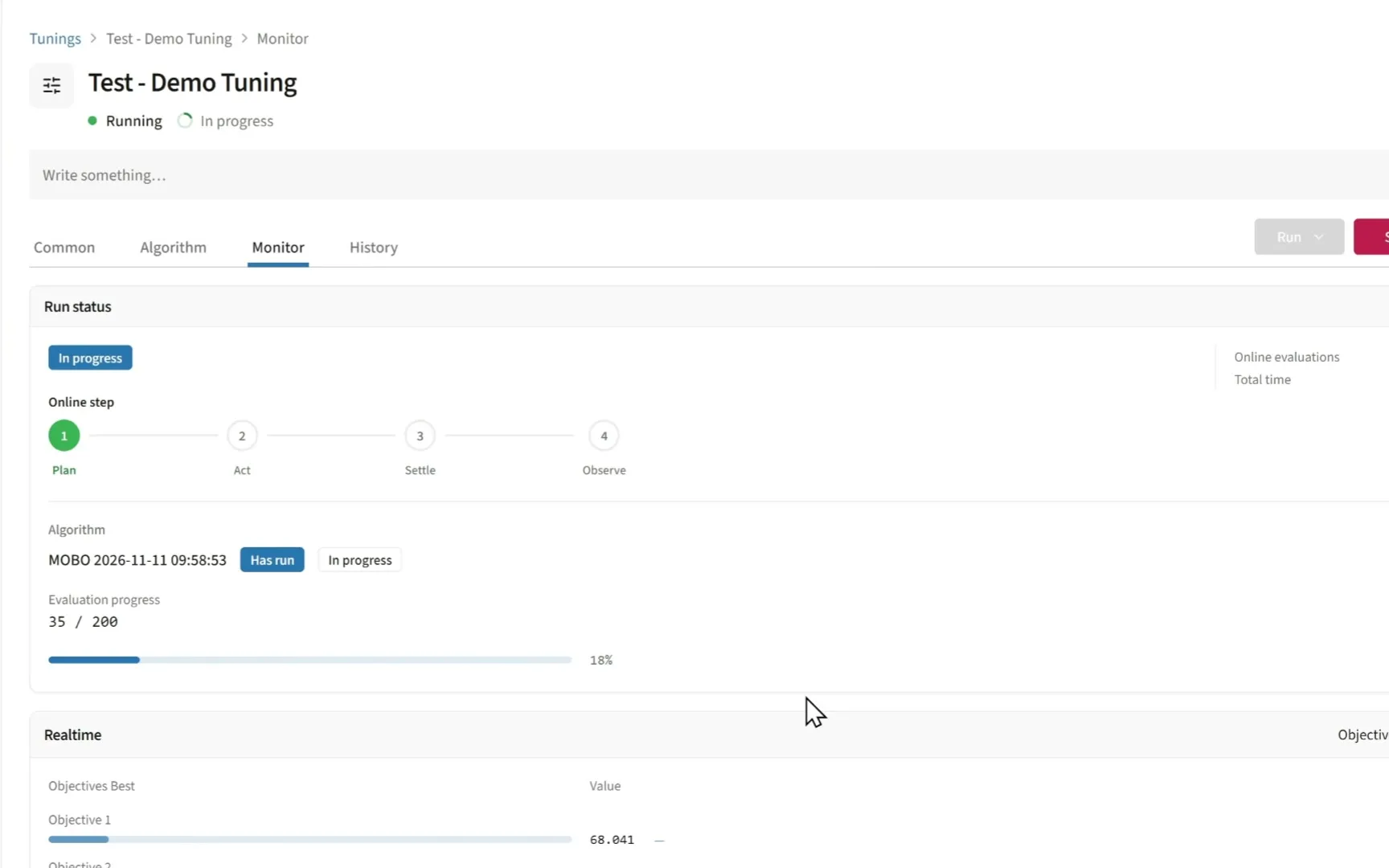
Connect every action with its observed result, giving each outcome both a trajectory and the process evidence needed for review and decisions.
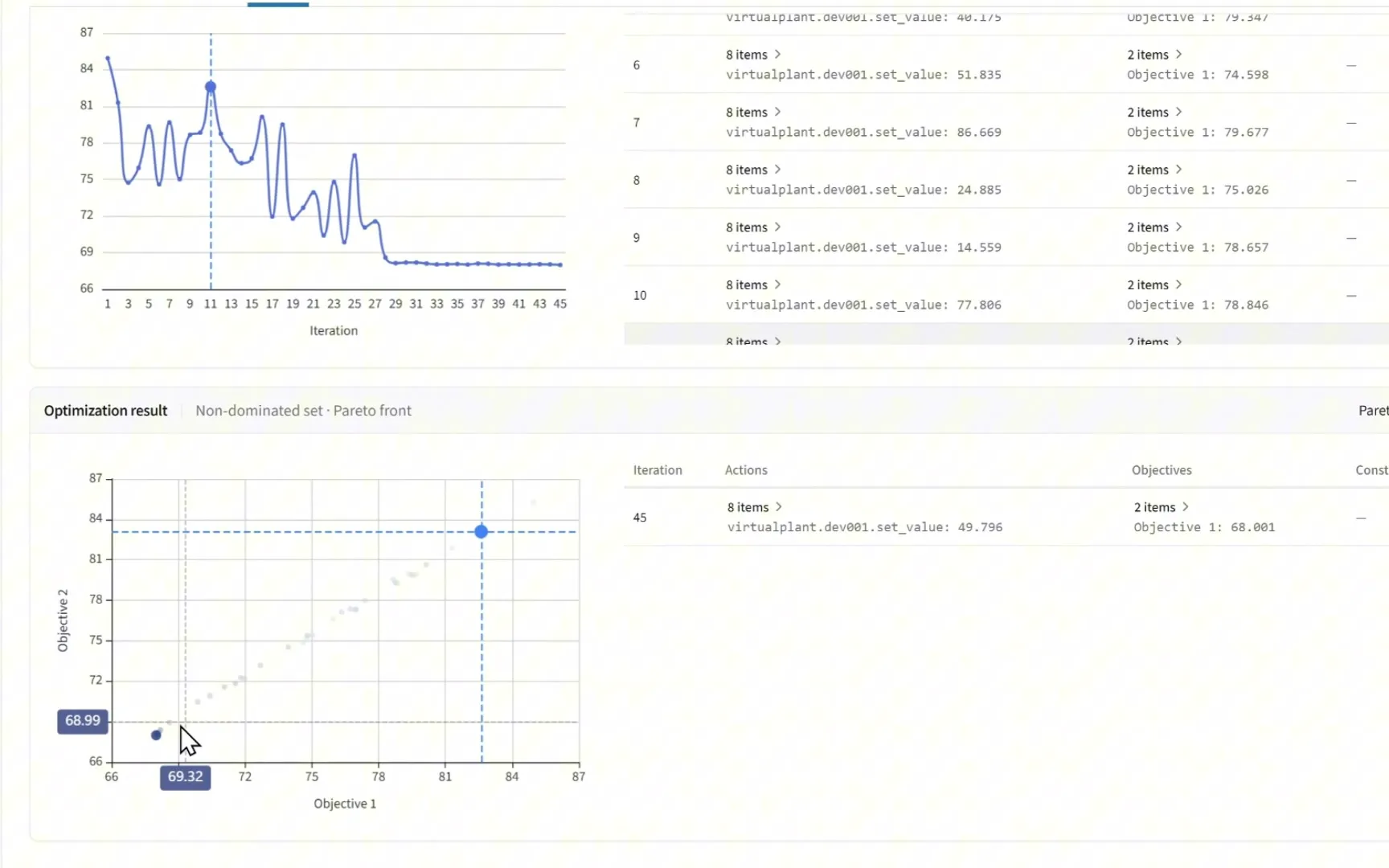
Put parameter changes, process responses, and objective performance on one timeline to understand field behavior and uncover optimization opportunities.
Choose methods for different objective counts, evaluation costs, and search characteristics, then save effective configurations as reusable templates.
Reduce repetitive trials while making optimization more controlled, evidence-based, and reusable. OptimLight turns algorithmic capability into a working method engineering teams can own.
Connect search, writes, settling, and evaluation instead of manually combining parameters and recording results.
Reuse objective, constraint, and algorithm templates to reduce repeated configuration.
Check permissions, parameter bounds, and constraint rules so algorithm output cannot bypass the write flow.
Retain configurations, actions, observations, and state changes for review and analysis.
Stop, pause, or resume when run states allow it, with configurable termination conditions.
Deploy the platform and retain data at the site without requiring internet access for normal tuning.
Retain results through run records and CSV exports for further analysis.
Multiple intelligent optimization algorithms for different objective counts and evaluation costs.
Every process has different goals, but each can build its own online tuning path from clear objectives, authorized parameters, and actual field data.
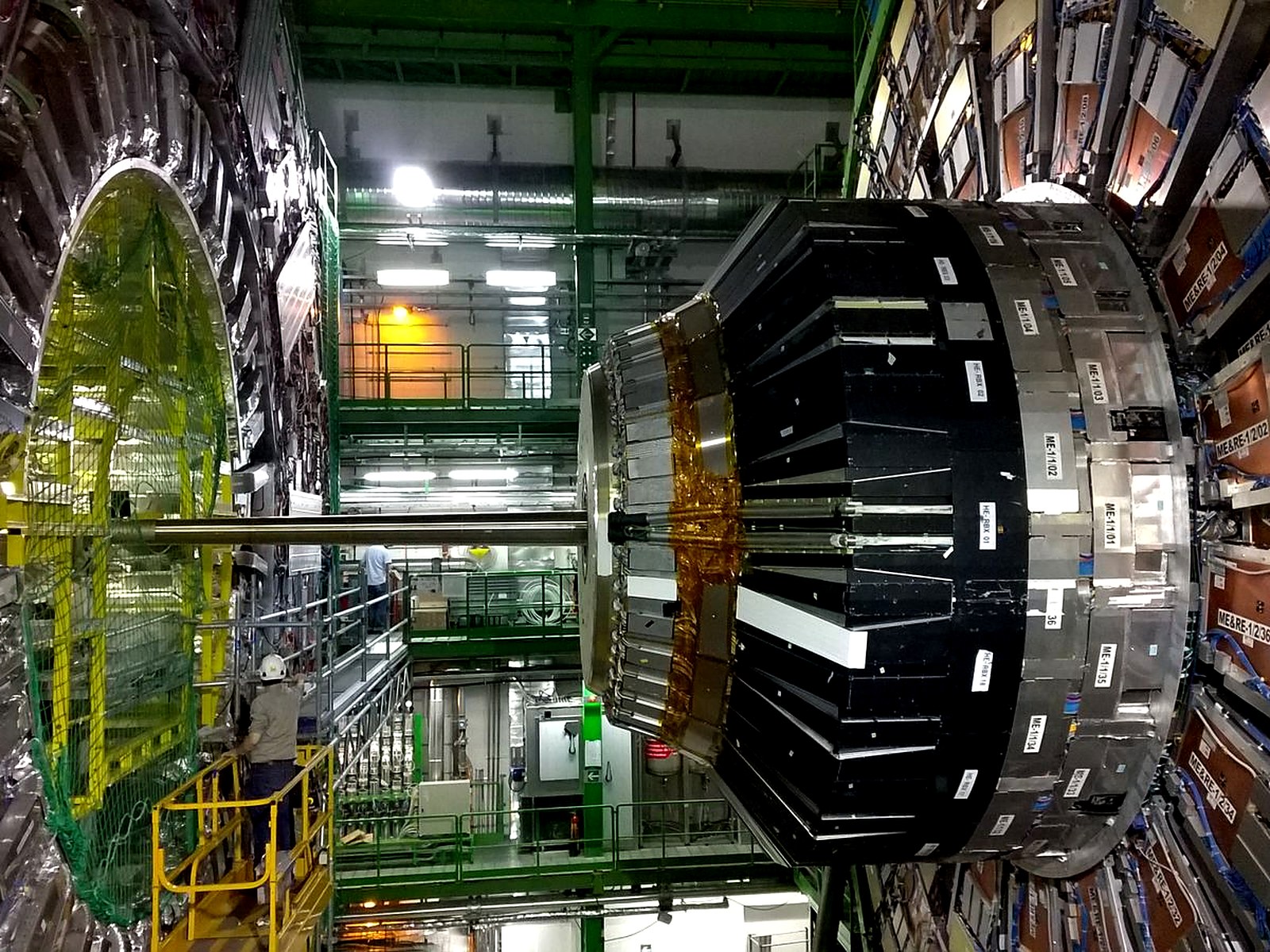
For research equipment and repeatable experiments, combining multi-parameter search with actual measurements and clear safety boundaries.
Automatic particle accelerator beam tuning
Build on continuous production and existing controls to explore a better balance across quality, energy efficiency, and operating performance.
Coal-fired boiler combustion and air-distribution optimization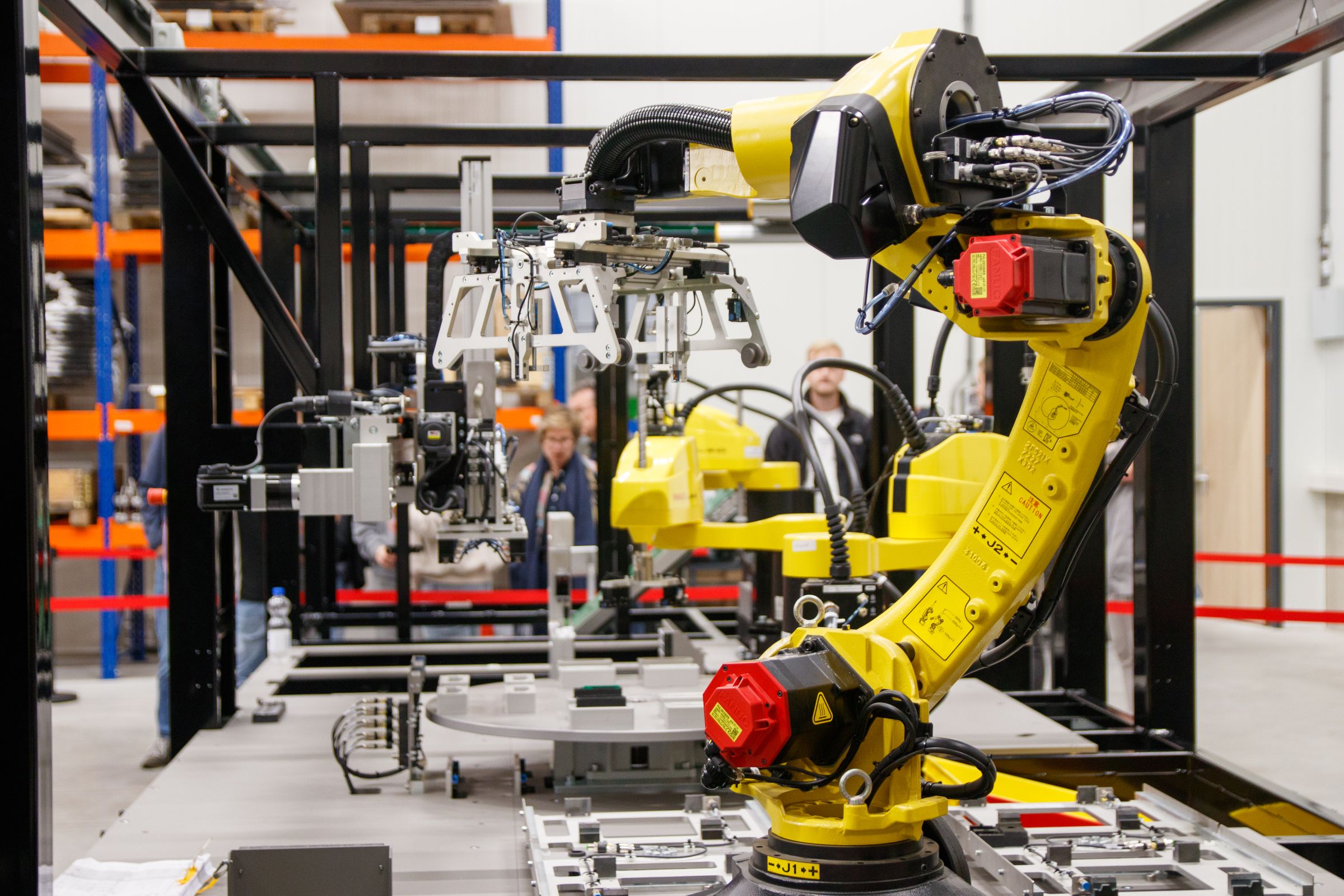
Connect quality, cycle time, process parameters, and equipment-control performance to improve manufacturing through repeatable, evidence-based trials.
Injection-molding process optimizationA concise guide to control boundaries, prerequisites, algorithms, deployment, and field connectivity.
View all questionsNo. Existing controls remain responsible for basic control, interlocks, and protection. OptimLight adjusts setpoints within authorized limits; algorithmic constraints never replace safety interlocks, protective circuits, or engineering judgment.
A site needs measurable objectives and constraints, adjustable parameters, accessible operating data, and authorized writable interfaces.
No. Selected Bayesian optimization algorithms support GPU acceleration and can still run on CPU when acceleration requirements are not met. A GPU accelerates computation, not field settling or observation.
Yes. The platform is deployed at the site, browsers connect over the site network, and business and process data remain on-site. Sites can be managed independently under their own policies.
Each write is followed by settling detection and then an observation window for measurement and evaluation. Settling criteria, observation duration, and evaluation rules must be configured for the specific process.
No. Ending conditions can reflect iteration budget, runtime, and objective performance. Users can also stop, pause, or resume when the run state allows it.
Watch the product demo to explore the complete workflow from objective setup and parameter adjustments to settling and evaluation. When the online trial opens, you can experience firsthand how OptimLight makes every adjustment evidence-based, traceable, and reusable.
The online trial is not yet available