

Evolutionary algorithms
Use population-based global search for tasks that benefit from exploring multiple candidates together.
GA, NSGA-II, and NSGA-IIIMatch the right method to the right problem across single-objective, multi-objective, and costly evaluations, then turn effective configurations into reusable templates.
Seven algorithms across evolutionary and Bayesian optimization cover single-objective, multi-objective, and costly-evaluation scenarios. Reinforcement learning remains in development.
Use population-based global search for tasks that benefit from exploring multiple candidates together.
GA, NSGA-II, and NSGA-IIIBuild surrogate models from existing observations for tasks with costly field evaluations.
SOBO, MOBO, TuRBO-1, and MORBO| Algorithm | Family | Objectives | Typical fit |
|---|---|---|---|
| GA | EA | 1 | Single-objective global exploration |
| NSGA-II | EA | ≥ 1 | Multi-objective search and Pareto sets |
| NSGA-III | EA | ≥ 2 | Problems with more objectives |
| SOBO | BO | 1 | Single-objective, costly evaluation |
| MOBO | BO | ≥ 2 | Multi-objective, costly evaluation |
| TuRBO-1 | BO | 1 | Larger single-objective problems with costly evaluation |
| MORBO | BO | ≥ 2 | Larger multi-objective problems with costly evaluation |
Algorithms produce candidate optimization results. Production suitability still requires review against field constraints, run records, and engineering judgment.
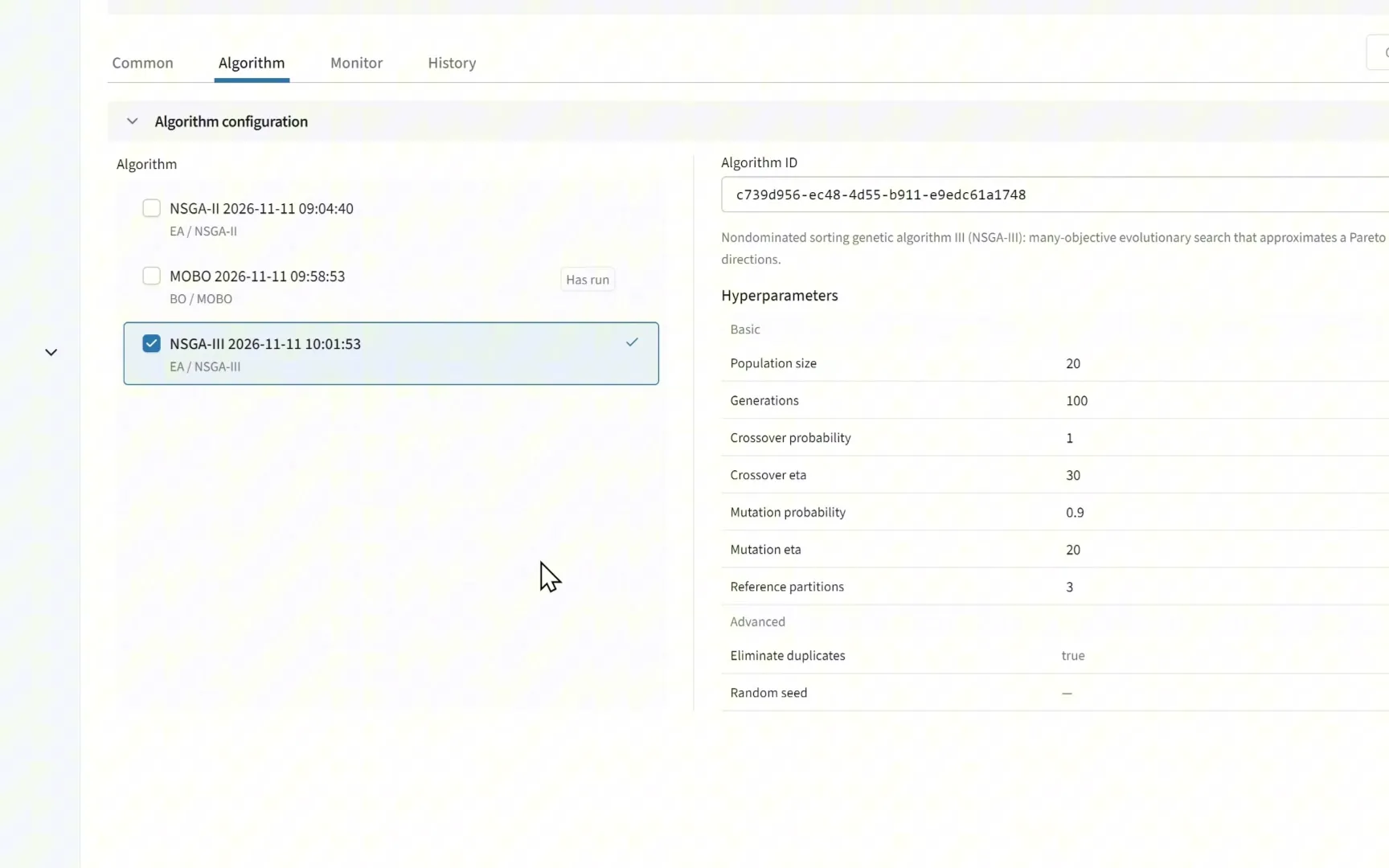
Save the algorithm, objectives, and parameter configuration that fit a problem as a reusable template. Reduce repeated setup and carry proven methods into later tasks.
Explore algorithm configurationBoth single- and multi-objective methods are available. Multi-objective results help teams understand trade-offs between competing goals.
Consider Bayesian optimization for slow or costly evaluations, and evolutionary algorithms for population-based global exploration.
Save effective algorithm configurations as templates and reuse them in similar later tasks.
Review objective trends, constraint evaluation, and field run records rather than treating one improved curve as a production gain.
Optimization algorithms can run on CPU by default. Selected Bayesian optimization algorithms also support optional GPU acceleration to fit available computing resources.
A GPU accelerates computation, not field settling or observation. The same algorithms can still run on CPU when acceleration requirements are not met.
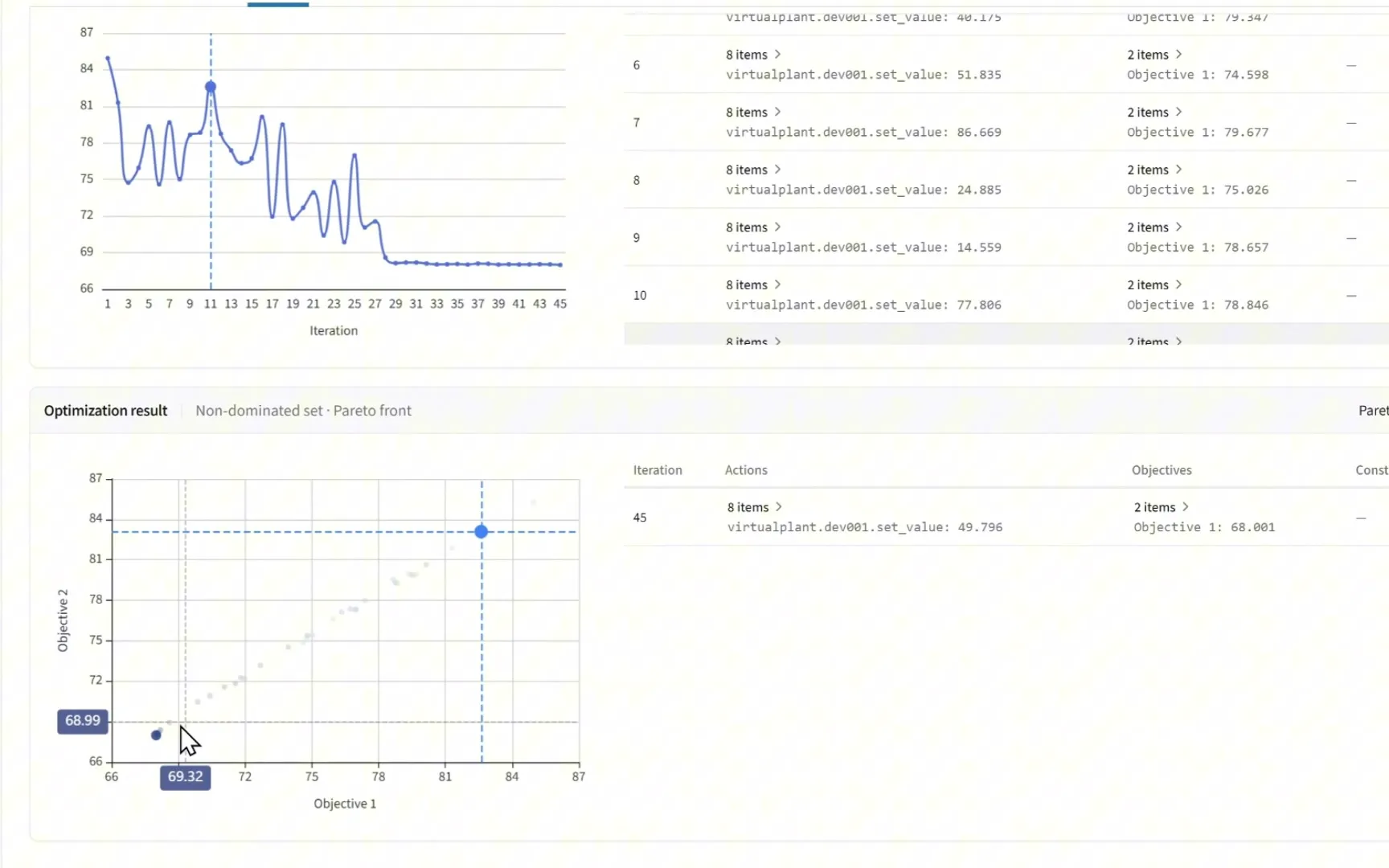
Watch the product demo to explore the complete workflow from objective setup and parameter adjustments to settling and evaluation. When the online trial opens, you can experience firsthand how OptimLight makes every adjustment evidence-based, traceable, and reusable.
The online trial is not yet available